
The Experiences Worth Finding
June 4, 2026
In late June last year, on a hillside above the Adda River valley in northern Italy, Greg and I spent an afternoon walking through vineyards with a man named Luigi who spoke not a word of English.
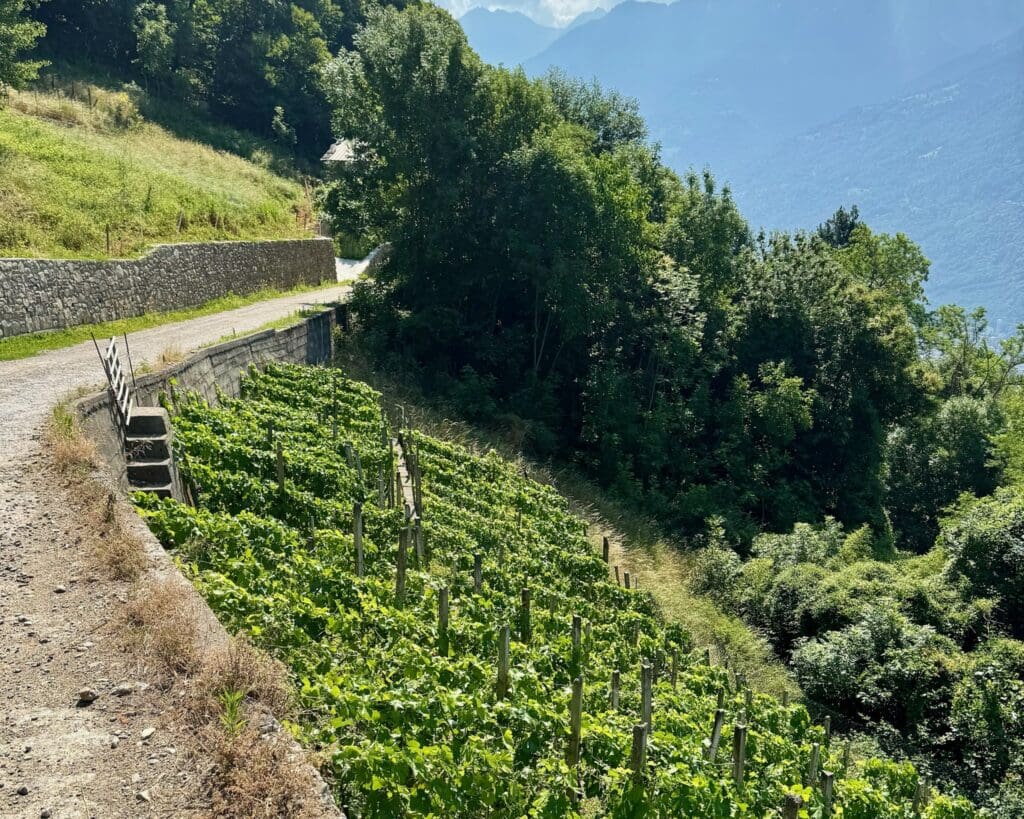
Valtellina isn’t a place most travelers have on their list. It’s a beautiful, narrow alpine valley in Lombardy, steep enough that every vine needs to be tended by hand. The grape is Nebbiolo, the same variety behind Barolo and Barbaresco in Piedmont, but grown here at altitude it produces something quite different: leaner, more mineral, with an earthiness that comes directly from the glacier-carved landscape around it.
We were there through a local tour operator with deep roots in the region. They introduced us to Terrazze dei Cech, a working cooperative whose members farm these terraces the way they always have.
Luigi was one of those members.
Before this trip, I’d never heard of Terrazze dei Cech. Our travel advisor worked with a local destination specialist who knew the region intimately. I shared what we love: wine, place, the kind of access that feels personal rather than packaged — and this is the experience that came from that.
The walk
Five kilometers along the terraces, starting in the late morning. We stopped three times at cellars built into the rock beneath glacier boulders and each time Luigi produced a bottle of wine alongside a charcuterie and cheese board – everything was made by the cooperative members, with locally sourced ingredients.
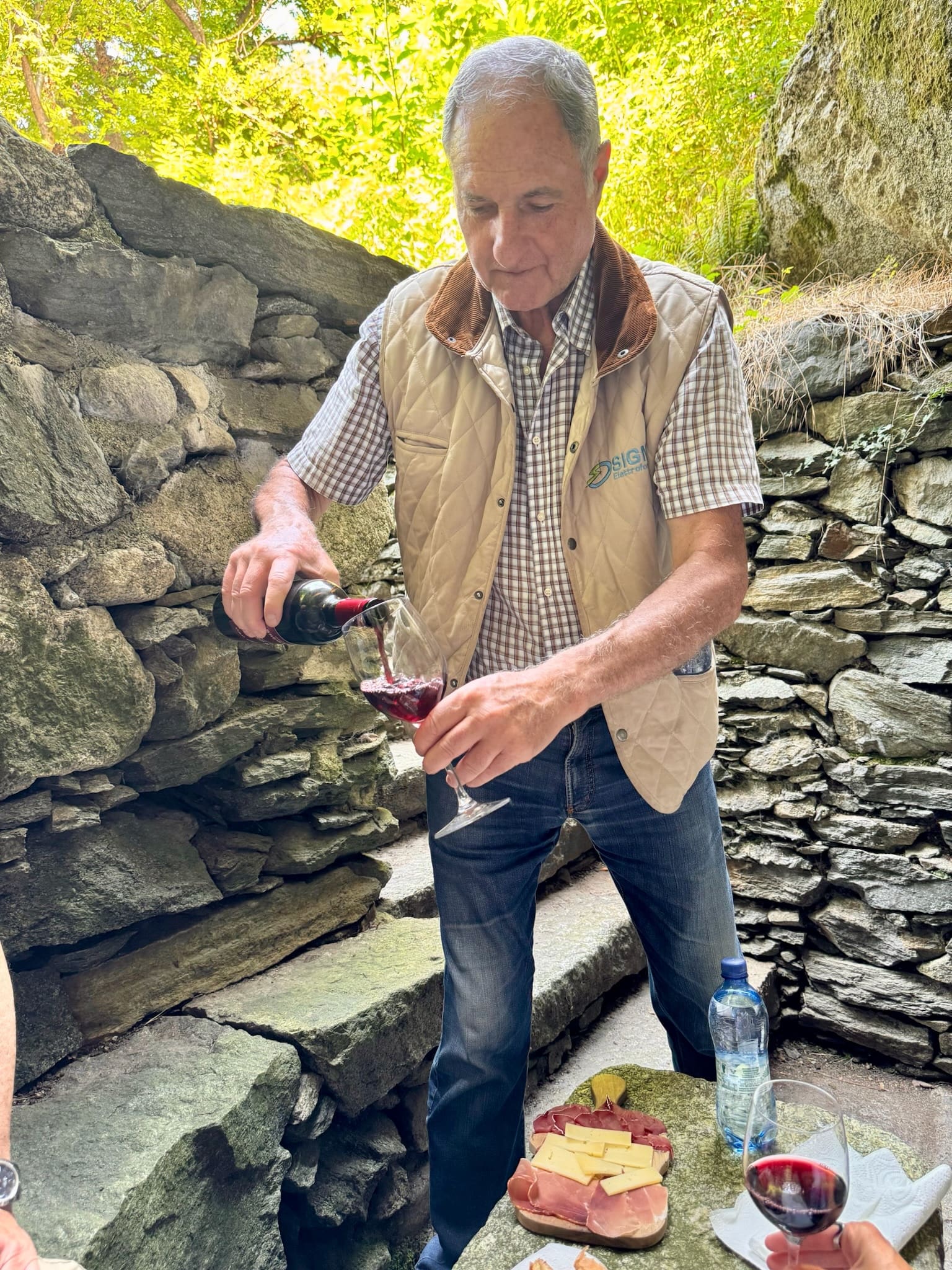
Along the way, Luigi also explained the land itself — pointing out the massive glacier boulders scattered across the hillside, remnants of the ice that once covered this entire valley. The cooperative members had built their cellars directly beneath some of them, using the natural insulation the rock provided.
At some point during the walk, he stopped to show me how they prune the leaves around a cluster: keeping some to shade the fruit when the sun sits at one angle, removing others to allow direct exposure later in the day. He was speaking Italian, demonstrating entirely through hand gestures and expression. I understood exactly what he was trying to tell me — my years studying wine had built a language we could share without sharing a language.
Lunch
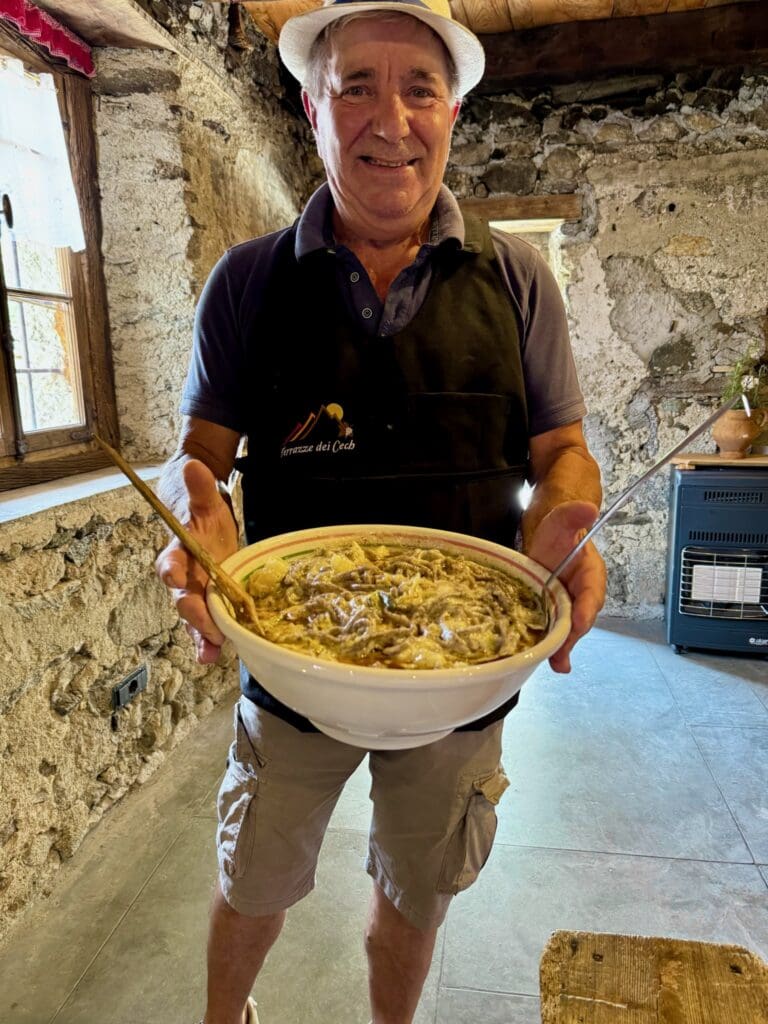
The fourth stop was the cooperative’s main building, which was a simple stone room. It was small and charming and clearly not designed for mass tourism. Lunch was made by another cooperative member. The main dish was pizzoccheri, the buckwheat pasta traditional to this valley, cooked with cabbage, potatoes, Casera cheese, and an embarrassing quantity of butter — everything made or grown by the cooperative members. The food was rustic and genuinely good, but what made the meal was the wholeness of it. Every element coming from the same hands, land, and valley we’d just spent three hours walking through.
After we’d finished eating, Luigi disappeared briefly and came back with a collection of unlabeled bottles — or nearly unlabeled; one said “GENEPY” in handwritten capitals. Local digestifs, made from local herbs and other produce, and strong enough to make you reconsider your afternoon plans. I tried them all and had a very comfortable nap in the car on the way back.
The wine room
Before we left, we asked about buying some bottles to take home. Luigi led us to a small room with a few shelves filled with the three wines we’d tasted that afternoon. The wines cost between 8 and 14 euros a bottle. Cash only. They don’t ship. We bought some of each — 80 euros worth — and carried it out. I may still have one bottle left.
You don’t know what you don’t know
Experiences like that afternoon exist all over the world. Sleeping under the stars on an open platform at Loisaba Conservancy in Kenya, the sky completely unobstructed. A hot air balloon drifting over the Maasai Mara before the day begins. A truffle hunt on a small family farm in Tuscany — one you can actually book directly once you know it exists, but only after someone pointed you toward it first.
Most of what makes travel extraordinary isn’t hidden behind a luxury price point. It’s hidden behind not knowing where to look or not having access as a consumer. You can’t search for what you don’t know exists, and advisors have access to these types of experiences. Some experiences simply can’t be found without the right relationships.
I know this from both sides. That afternoon in Valtellina happened because I was someone’s client, not because I found it myself. What I do now for the people I work with is exactly what made that day possible for us — staying close to the ground in destinations around the world, building relationships with operators who have genuine access, and understanding my clients well enough to know when something is right for them. That kind of afternoon doesn’t come from an online search. It was built around knowing the place, knowing the people, and knowing what matters.


