
The Infrastructure of a Great Trip
April 28, 2026
There’s a moment on every trip when you stop traveling and actually arrive. Not when the wheels touch down, but something subtler — a shift in your nervous system when the weight of everything you left behind stops competing with where you are.
That moment doesn’t happen automatically. And how quickly it happens — or whether it happens at all — depends almost entirely on two foundational decisions: where you stay and how you spend the first 24 hours.
The First 24 Hours
Arrival day is rarely treated as anything but logistics. When to depart, when to land, and when to check in. But the truth is that arrival day is one of the most consequential parts of trip design.
For international travel, it’s about your body. A mid-to-late afternoon arrival often works best — enough time to get settled, unpack, take a walk, have dinner, and be in bed at a reasonable local hour. The key is movement.
Walk. Stay upright. It’s the single most effective thing you can do on day one. One of the best examples is arriving in London mid-day, checking in, unpacking deliberately (this signals to your brain that you’re actually here), then walking through Hyde Park on an autumn afternoon for a couple of hours. Simple dinner at a local pub. Bed by 9:30. Awake refreshed at 5:30, ready for a full day without the fog that haunt first days of international travel.
For domestic travel, the problem isn’t your body — it’s your mind. When you’re perpetually scheduled, you can be physically present at a beautiful property and still mentally at your desk. This is where ritual becomes important.
Before arriving at Little Palm Island in the Florida Keys, you drive Highway 1 through the Keys — water on both sides, the pace slowing you down, the landscape shifting gradually from city to something quieter. That’s where you stop at a waterfront spot for a blackened grouper sandwich and a crisp white wine, unhurried. By the time you arrive at your destination, the mental load has already begun to lift.
The Hotel as Infrastructure
But arrival day only works if the hotel is positioned to support it. This is where most people treat the hotel question as a pure logistics decision — points, brand status, availability. Those matter less than you think.
The real question is: what do you want the hotel to do for this trip?
There’s a story from 1997, on a desperately needed vacation in Hawaii. We chose the less expensive hotel to stretch the budget. It was tired, dirty, mediocre — and we spent half a vacation day on the phone trying to escape it. When we moved to the Grand Hyatt, everything changed immediately. The pool attendant remembered our name the next day. That’s when something clicked: the hotel isn’t the backdrop. It’s the infrastructure. Get it wrong, and everything else has to work harder. Get it right, and it quietly elevates everything.
There are two categories of hotel excellence worth understanding. The first is what major global brands do well: consistency, reliability, a recognizable standard wherever you are. A Four Seasons delivers predictable quality. That has real value.
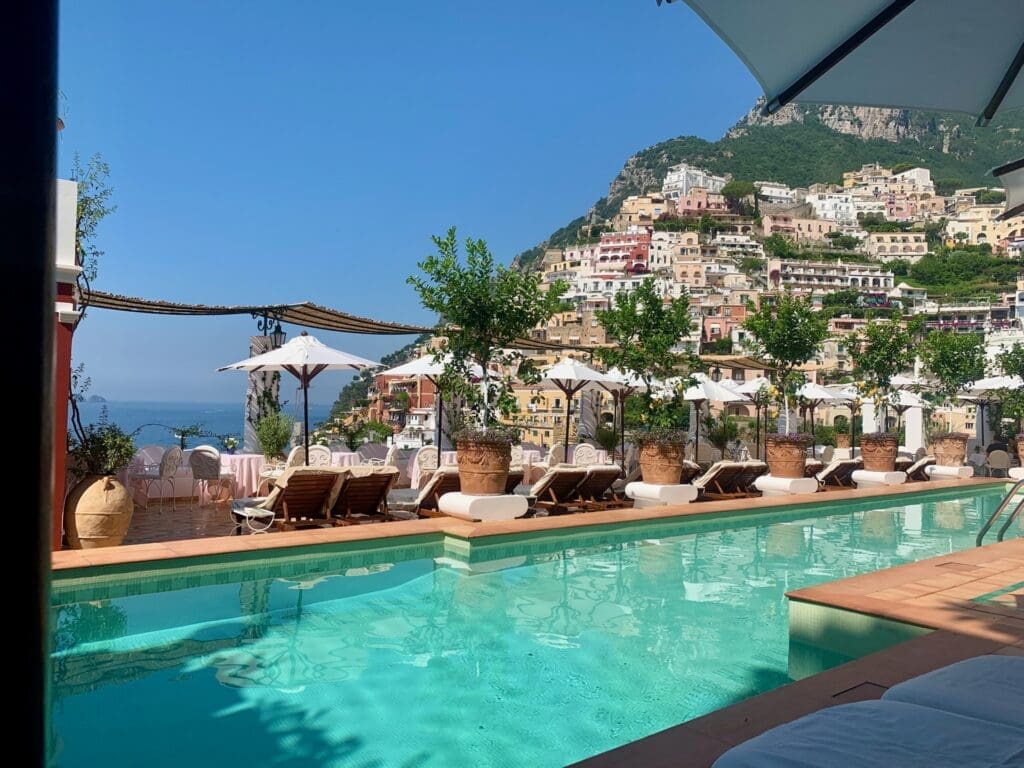
But there’s a second category — properties so deeply rooted in their location that they feel less like they were built and more like they grew there organically. Le Sirenuse in Positano isn’t just on a cliff with views. The concierge knows the restaurants tourists won’t find. She asked the right question and sent us to a small place where you could see Nonna in the kitchen, and the food was the perfect expression of the Amalfi Coast. That’s a hotel that belongs to its place. It opens doors into the destination you wouldn’t find on your own.
These properties share something: location isn’t just a setting. It’s the reason the hotel exists. And the service, when it’s best, is quiet — anticipated rather than announced.
What This Means for Planning
The hotel question comes up early in almost every planning conversation. What kind of property should anchor this trip? Does this trip call for a property at the center of everything — walkable, energetic, connected to the city? Or something that functions as a sanctuary, somewhere that genuinely restores you?
On arrival day especially, the ability to simply walk out the door and be somewhere worth being is invaluable. This is one of the reasons hotel location is a foundational planning decision, not a secondary one.
When the hotel is right — when it’s positioned in a place that works for arrival day, when the neighborhood is the activity, when early check-in is possible — the first 24 hours align. And the trip begins the moment you arrive.


