
Nine Rooms, No Slack
September 15, 2026
My last issue was about how our Spain trip took shape: the flight credit, the back-and-forth between known and new, the itinerary trifecta, and how we landed on five stops. This one picks up the thread I mentioned then: how close some of that came to not working out at all, and what almost losing one of the most important parts of the itinerary reinforced something I already knew, but apparently needed to relearn.
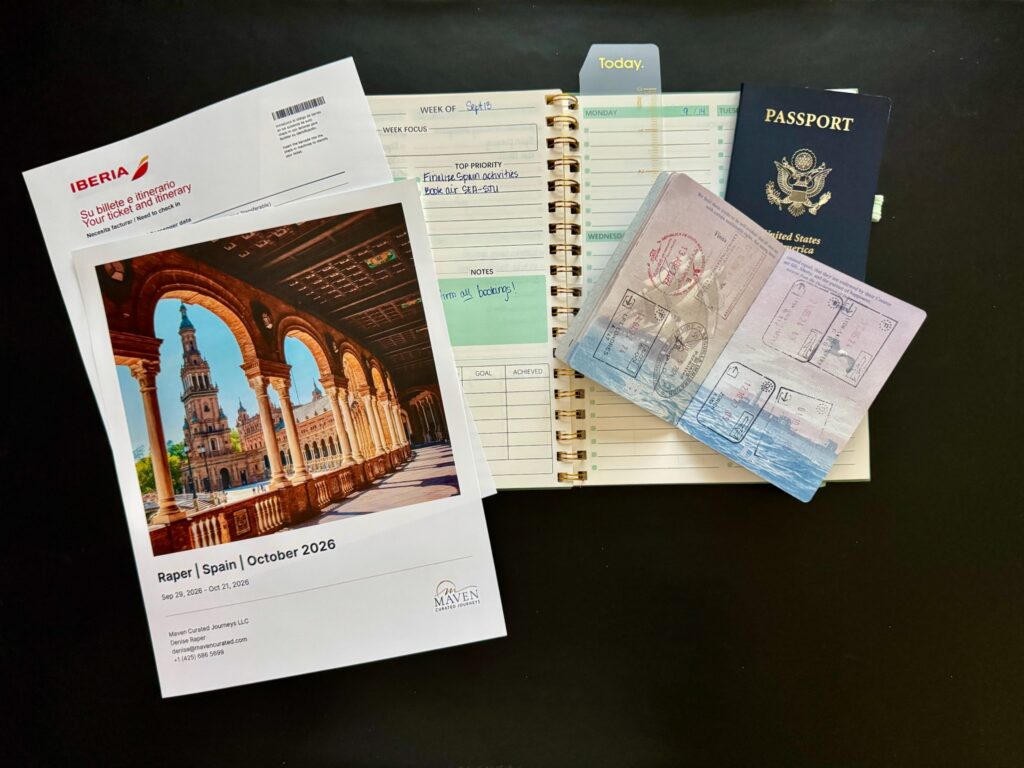
I tell clients to book early. I mean it, and I say it often, especially for anything with limited inventory or a defined high-demand window. And then I let my own accommodations sit unbooked for months while my son’s wedding, a bout of being sick right after it, and a client list that’s kept me busier than usual this summer all took priority over my own trip. I’m not proud of that. I’m also not going to pretend it doesn’t happen, because it clearly does, even to someone whose job is knowing better.
Not every trip component carries the same risk when you wait. A four-hundred-room hotel in a city almost always has something available, even close in—you might not get the room you wanted, but you’ll get a room. A nine-suite property in Rioja, during harvest, has no slack at all. You either get one of the nine rooms or you don’t, and there’s no fallback tier underneath it in an area with very few large hotels. Risk in a trip doesn’t spread out evenly. It concentrates wherever the inventory is smallest and the demand is highest, and those are the plans that need attention first.
I looked into how this plays out across categories, because I believe it’s useful to know the numbers rather than operate on instinct and hope.
Hotels split roughly into three tiers:
- Large chain hotels are the most forgiving. The depth of inventory means something is usually still available much closer to your arrival date, even if the price has moved due to demand.
- Boutique properties (the ten-to-forty-room range) often sell out weeks to months ahead, and in a high-demand destination or a defined peak window, three to six months out is the general guidance if you want your pick of room types and even longer if you want to secure the best rates.
- The smallest-inventory categories—safari camps, small island resorts, and, as it turns out, a nine-suite property in wine country during harvest—sit further out still, six to twelve months in peak season.
Cruises run on their own clock. Six to twelve months out is standard guidance for the best combination of price and cabin choice. Luxury and small-ship lines need closer to twelve to eighteen months, since there aren’t many cabins to begin with and the good ones go first. Suite and premium categories can sell out over a year ahead even on larger ships. The side of the ship your cabin is located on matters too, sometimes as much as a deck does. On itineraries that run mostly one direction along a coastline—Alaska’s Inside Passage or certain Mediterranean routes—one side gets meaningfully better views for most of the sailing. Those cabins go first, regardless of category. Compressed-sailing expedition trips and world cruises can sell out within days of opening for booking.
Greg and I ran into this while I was writing this issue, actually. I just booked a Ritz-Carlton Yacht Collection sailing for us on the Ilma for this December, about three months out. We’ve sailed her before, and we have a favorite cabin category and location—I’ll leave the why to anyone who wants to ask me directly, as it’s the kind of insider detail I’d like to gatekeep. By the time we booked, that combination was gone entirely. What was left sat primarily on Deck 9, which puts us directly beneath the pool deck, a near-universal no-go in cruise cabin selection. We landed on a decently-positioned cabin on Deck 7. A fine outcome, just not the one we’d have had booking further out.
Air mostly runs on dynamic pricing, and the airlines aren’t the only ones using it anymore. Airlines recalculate fares continuously against how fast a route is booking and how much demand they’re forecasting, so the same seat can price differently by the hour. Hotels and cruise lines have started doing versions of the same thing with more sophisticated pricing software.
It’s worth knowing how it works, but I’m not going to hand you a specific week to book by, because the moment a rule like that gets repeated enough, the algorithms adjust around it. What’s more useful is knowing how to actually watch a fare rather than guess at it. Set a price alert on the specific route through an online tool like Google Flights or Skyscanner, rather than checking manually and trying to remember what it cost last week. Clearing cookies or searching in an incognito window doesn’t do anything. A widely cited test of nearly 400 flight searches, conducted by Consumer Reports, found no meaningful price difference between incognito and regular browsing. It makes sense once you understand how the pricing actually works: it’s reacting to overall market demand and how fast a fare class is filling, not your personal search history. Watching how a specific fare actually moves over a couple of weeks tells you more than guessing at a fixed date to book by.
Activities have the widest range of all. A solid restaurant reservation usually just needs a couple weeks. The truly exclusive tables work differently: many run on a hard release window, thirty to sixty days out, at a specific time, the whole month of availability appearing at once rather than trickling in over time. Anyone who’s ever tried to get French Laundry reservations knows this. Broadway-level shows need weeks to months for a good seat on anything with buzz. And timed-entry sites with a hard daily cap behave like the nine-suite hotel problem. Granada’s Alhambra is the example sitting right in my Spain itinerary. The Nasrid Palaces cap at three hundred visitors per half-hour slot. Tickets open three months ahead, and summer and holidays sell out weeks to months in advance. That was the first activity I booked for our Spain trip (a month ago), and even then, there were only two available time slots over our three-day stay in Granada.
Which brings me back to Rioja, and that email I told you about last time. If my top choice hadn’t had a single opening left across those twenty-three days, I’m not sure what this trip would have looked like—a different region entirely, probably, or a version of Spain without the wine week I’d actually hoped for.
Thankfully, now I’m caught up with my planning and starting to enjoy the part of this that’s just imagining the actual days once we’re there.


