
Notes from Spain: What Held UP When the Itinerary Didn’t
October 20, 2026
In my last newsletter, I wrote that everything about our Spain itinerary made sense on paper. Now I was going to find out which decisions actually held up once we were living inside it.
Spain didn’t make me wait very long for answers.
Last week we left our hotel in Mallorca at 7:30am for our flight to Granada. The flight was delayed. Then delayed again. And again. By around 1:00pm, after we had already half the day at the airport, Greg and I left the lounge to get lunch. When we checked the departure board again afterward, our flight had been cancelled.
A little later, as we were beginning to navigate the rebooking process and waiting to pick up our luggage, the airline sent us its solution via email: our new flight to Granada would leave four days later. Our Granada stay was only three nights.
For the next couple of hours, I tried to figure out whether there was still a way to save that leg of our trip. There were alternatives, but every viable option required an overnight connection in Barcelona or Madrid. Our three-night stay would have become, at best, one night in Granada surrounded by two more transit days. The winery experience we had planned was already gone. So was our Alhambra reservation, because we couldn’t get there in time.
Somewhere on the drive back to our hotel, the answer became obvious. We were going to just let Granada go. I’m genuinely sad that we missed the Alhambra, but I have absolutely no regret about the decision. At that point, preserving Granada would have meant protecting the itinerary at the expense of the trip.
That decision was also the easy part. Then I had to unwind everything: the hotel, two tours, Alhambra tickets, our train to Seville, the cancelled air, new flights directly to Seville, three additional nights in Mallorca and all of the documentation I would eventually need for travel insurance.
Eight different vendors in total.
There were some bright spots. Our Granada hotel was already inside its non-cancellation window, but rather than simply cancelling online, I contacted them directly, explained what had happened and asked if they might make an exception. They graciously waived the cancellation penalty entirely. Other pieces have been less straightforward. I’m still waiting for final information about one of the missed tours so I can understand what is actually non-refundable and file the insurance claim.
The airline situation was predictably frustrating. The flight had been booked through one carrier and operated by another, which meant each pointed us toward the other when we tried to find an alternative. Eventually we stopped trying to make the original routing work, chose the refund we were entitled to under EU passenger-rights rules, and booked a completely new flight directly to our next destination, Seville.
Before we headed back to the hotel we had checked out of that morning, Greg contacted the concierge, whom he still had on WhatsApp, and confirmed they had rooms available. Even better, the room we had just vacated was still available. The Virtuoso rate I could access was also considerably better than the hotel’s BAR (best available rate), so once we arrived and I had reliable Wi-Fi, I booked the extension while sitting in the lobby.
There was something psychologically helpful about walking back into the same room, with the same giant terrace looking out over the Mediterranean, and putting our things back where they had been that morning. Once we unpacked, the extra nights felt more like a continuation than an entirely new plan.
A lot of continuation, as it turned out.
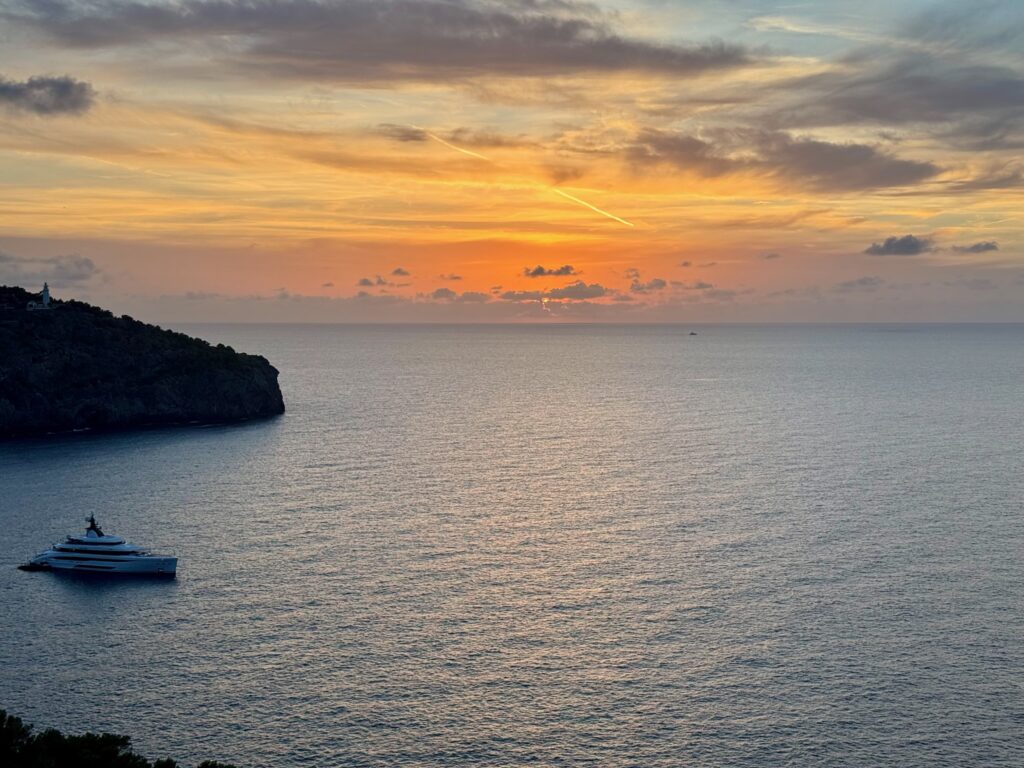
We truly loved Mallorca, but eight nights in Port de Sóller is more than I would intentionally plan. Two of our three unexpected extra days were gray and rainy, although the evenings cleared and gave us some of the best sunsets of our stay.
This is not going to turn into one of those stories where a disruption secretly made the trip better – it didn’t. It just didn’t ruin it. On the evening of the cancellation, I finally stepped away from my laptop at 6:45pm. Things were still unresolved, but I couldn’t give up the entire day to the problem. We got cleaned up, went upstairs to the Sunset Lounge, ordered a cocktail and watched the first really spectacular sunset we’d had since arriving 5 days prior. That was the first point, after the disruption, when I felt like I was on vacation again.
Travel insurance does not make a disruption pleasant. What it does is give you room to make the better travel decision without having to keep chasing a bad one simply because you’ve already spent the money. I haven’t filed our claim yet, so I don’t know exactly what will be reimbursed. But between the non-refundable pieces of Granada and the additional costs created by the disruption, I’m very glad we had it.
What it couldn’t give back was the day. Nearly an entire vacation day disappeared into recovering the trip.
If this had happened to one of my clients, they still would have had to make the important decision: try to rescue Granada or let it go. But they would not have needed to spend hours figuring out what was possible, unwinding reservations, chasing documentation and trying to determine who was responsible for what.
The first answers
The Granada disruption wasn’t the only test. Before we left, I also wondered whether some of the premiums I had paid for this trip would actually change the experience enough to justify them.
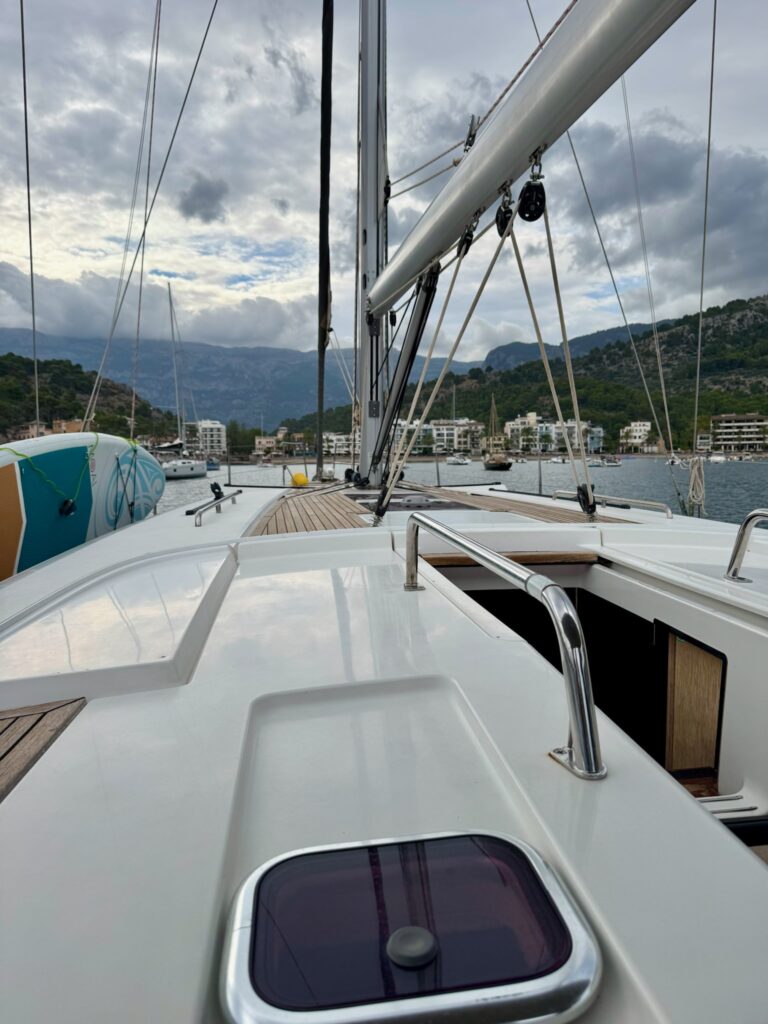
The private sailboat in Mallorca was probably the cleanest example. I paid roughly four times what a shared excursion would have cost for four hours on a private sailboat out of Port de Sóller. Part of the rationale absolutely held up. We walked down from our hotel and boarded in Port de Sóller rather than spending nearly an hour transferring to Palma. We had the boat to ourselves. Nobody annoying was occupying the best seat. Nobody’s music was bothering me. There was plenty of room.
Those were the variables I paid to remove. But the experience itself didn’t justify the premium. There wasn’t enough wind to sail, so we slowly motored north along the coast. The cliffs were stunningly beautiful, and we stopped for a while in a little cove, but the air was a little too cool for me to swim.
Our captain was perfectly nice, but there wasn’t much interpretation of what we were seeing. We had nice Albariño and Verdejo but the snacks consisted of a small bowl of potato chips and some mixed nuts. At that price point I expected more.
I’m glad we did it. I always love being on the water, and the privacy did have value. But would I pay that premium for that particular experience again? No.
That doesn’t make it a bad day. It makes it useful information. If Greg and I were simply on vacation, I probably wouldn’t be analyzing every component this closely afterward. But I’m also experiencing these hotels, guides, suppliers and destination specialists with clients in mind. So, the question is not just whether I enjoyed something. It’s whether I understand its value well enough to recommend it to someone else.
Seville
Our replacement flight eventually got us to Seville three days later, although getting there reinforced something I already knew: I am not built for budget-airline travel.
We knew the luggage limits before we left the hotel, so packing involved strategically moving anything heavy and non-liquid out of our checked bags and into our backpacks. This solved the luggage-weight problem while creating a new one in which we had to carry absurdly heavy backpacks through the airport. The flight itself was completely fine, and once we reached Seville the trip settled back into a rhythm remarkably quickly.
Our hotel in Seville was a big part of why six nights here worked so well. We were a stone’s throw from the Cathedral, but oddly removed from the main tourist flow on a small pedestrian alley. The Alfalfa neighborhood was an easy walk for dinners. Triana was a little farther, but still close enough that we could wander there without making it an expedition.
Our balcony looked directly at the Cathedral. Morning coffee came with the sunrise—which, surprisingly, wasn’t until nearly 8:30—and in the evening the light shifted the other direction while we sat outside with a glass of wine or a cocktail. It was central without feeling as though we were sleeping in the middle of a tourist attraction, and that has been one of my favorite things about Seville generally.
It’s busy. There’s a buzz to it. But it rarely felt chaotic.
I also noticed how little of the aggressive street selling we’ve encountered in cities like Rome and Paris there seemed to be. Very few people trying to put something in your hand, sell you a purse or launch a glowing object into the air while you’re trying to walk.
At night, the city really came alive. This weekend was particularly lively because Monday was a national holiday, but what fascinated me wasn’t simply that people were out late. It was who was out late. At 11:00pm, tapas bars and sidewalk tables were filled with families, groups of friends, children and older parents. People were eating, drinking, talking loudly and laughing. I walked down one street filming a video because I wanted to remember what it felt like. Almost all I could hear was Spanish.
It didn’t feel like nightlife in the way we usually use that word in the U.S. It didn’t feel like people had gone out to party. It felt social and communal, like this was simply where everyone was supposed to be. I loved it.
Six nights in Seville was about right, particularly with Jerez as a day trip. We had time to see the major sights, wander through neighborhoods, spend time at the market, eat very well, and still have afternoons when nothing was scheduled.
There are things we didn’t do. We never made it to Plaza de España. There’s more of the Santa Cruz neighborhood I’d like to explore. Two of our guides told us Ronda would make a great day trip. However, I don’t need to leave a city feeling as though I completed it. I’d rather leave with reasons to come back, and now the unfinished business in Seville and missed trip to Granada gives us a very good one.
The dinners we deliberately left loose also worked—at least until I reached the point where I told Greg I’d really prefer not to eat any more dinners composed entirely of tapas. This is not a criticism of tapas. I have developed a very serious love of braised Iberico pork cheeks and the Spanish omelette, and we found a tapas bar we liked enough to eat lunch there three times. But eventually there are only so many variations of small plates. For our last few nights we ended up making reservations.
Private is not the same as access
The question I’ve been thinking about most, though, is the one I posed before we left about the local destination specialists I’m testing.
Last year in Valtellina, we had the kind of day that permanently changed my standard for what a really good local specialist can do. We walked terraced vineyards with Luigi, stopped in rock cellars I didn’t know existed, ate lunch prepared by members of a small cooperative and spent a day inside a world I never could have found by searching for the “best private wine tour.”
That is still the gold standard. Nothing in Spain has matched it quite yet, but Jerez got close enough to help me understand the distinction I’ve been trying to make.
Our first stop was Bodegas Tradición, which I booked myself directly. I specifically wanted a private experience that went deeper into how sherry is produced because I already knew the technical side from studying for my sommelier exam, but Greg didn’t. I thought he would enjoy actually seeing and tasting what I had tried to explain to him. We tasted from barrels at different stages of the aging process, which made the solera system tangible rather than theoretical, and then tasted the finished wines.
And then there was the art.
Bodegas Tradición isn’t only a winery. Its founder, Joaquín Rivero, was a serious art collector who opened a gallery inside the bodega in 2005. The collection includes more than 300 works of Spanish art spanning the 14th through 19th centuries, including Goya, Velázquez, Murillo and El Greco.
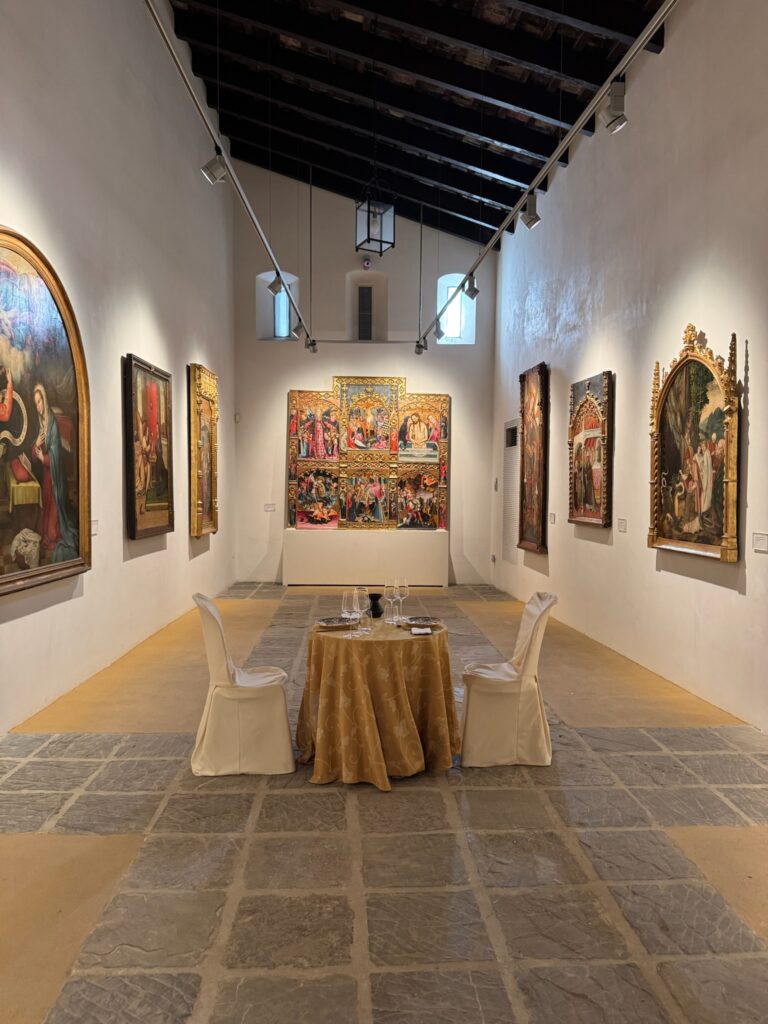
For lunch, they closed the gallery for Greg and me. There was one small table for two in the middle of the room, surrounded by paintings that would not have seemed out of place in a museum. No barriers around them. No other visitors wandering through. Just us. Our winery host and another server came in for each course, poured the sherry paired with it, served us, and left again. Even our guide for the day wasn’t with us. We were simply sitting alone in the middle of this remarkable collection eating a multicourse lunch. It was kind of insane, and it was wonderful.
The second winery was completely different. Because I had booked the first winery appointment for Saturday, the local destination specialist had difficulty finding a second one to go to because most are closed on the weekends. We thought the second stop might have to be a tabanco instead, but our local guide had a relationship with Jaime, the owner of Bodegas Faustino González, a small family producer whose wines are bottled under Cruz Vieja. She called him to see if it was possible for a visit, even though they were closed on Saturday, and he agreed.
We walked down a small alley to a nearly unmarked enormous wooden door. Our guide knocked, Jaime opened it, and we stepped directly into the barrel room. Jaime told us how the bodega had started with his father, then went to one of the solera barrels and pulled a sample of fino for us. Eventually we moved into a small courtyard where he had set out glasses on a modest table.
We tasted through the progression of the wines while Jaime talked about each one. His English was good enough that we understood what we were drinking but not quite good enough for a deep technical conversation.
It didn’t matter. We had already had the technical education that morning. This felt completely different. It felt like visiting someone’s house.
Jaime was excited to share what his family makes. We asked questions. He poured. We talked. There was nothing polished about it. This was much closer to what I had been looking for. It still wasn’t Valtellina, but it was access. And access is not the same thing as private. Private describes the format. Access is what becomes possible because the right person knows whom to call.
Bodega Tradición was exceptional because I knew what I wanted, found the right experience and booked it. Faustino González was exceptional because somebody local knew a door that wasn’t otherwise open that day—and knew the person on the other side of it. Both experiences belong in a great trip. They just arrived there by different paths.
A local destination specialist earns their place when their judgment and relationships add something I could not readily create myself. Can they get me to the guide I wouldn’t otherwise have access to? Open a winery that isn’t open? Arrange something I didn’t know existed? Make the sequence of a day better because they understand the place more deeply than I do? And when something breaks, do they step in and help solve it?
Sometimes the right answer for a client will be something I source directly. Sometimes it will be a local specialist whose relationships unlock something neither the client nor I could simply book online. Deciding which path gives the client the stronger experience is my job.
One of the specialists I’m testing has arranged great guides, but I’m still struggling to see where the additional layer materially improved those experiences. The same company has also required more chasing than I would have expected around the missed Granada tour.
That matters because the point of this trip is not to prove that every private tour is worth the premium or that every destination specialist produces magic. It is to figure out who and what I trust enough to recommend to someone else.
We’re in Rioja now, where the other local specialist I’m testing has two full wine days planned for us. Valtellina is still the benchmark. Jerez got close. That’s the standard I’ll be carrying into the rest of this trip—and into the trips I plan for clients.


